No surprises in a release
You know what is changing and when, before it reaches your customers. Nothing arrives that you have to explain to them after the fact.
How we work
Enterprise software rarely fails because of a technical decision. It fails because nobody owned it, nobody wrote it down, or the hard questions were left until a customer was waiting. We work in the order that avoids that.
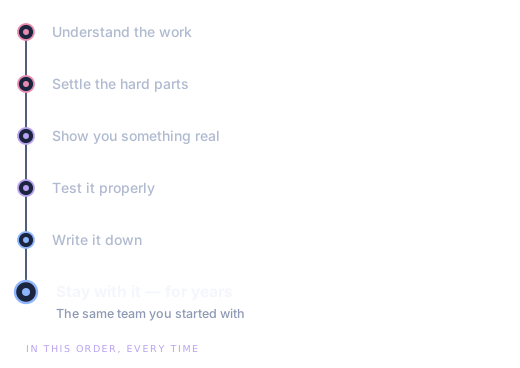
Our approach
Six stages. The last one runs for years, and it is the one that decides whether the first five were worth paying for.
Not the person signing the contract — the person who will be using this at three in the morning. What is their workaround today, what goes wrong, and what would they stop doing if this existed. Get that wrong and the rest is wasted.
Who is allowed to see what. How one customer’s information stays separate from another’s. What has to be provable afterwards. These cost days to decide now and can cost a rebuild once real customers are on the system.
One complete journey through the product before we build breadth. You react to something you can use rather than to a specification, and we find the awkward questions while they are still cheap to answer.
We probe it the way an attacker would and examine it the way an auditor would, while the product is still small enough to fix cheaply — not in the week before a customer’s security review.
Whoever has to run, integrate or audit the product needs it explained, and none of them will call us first. So it is written as the work happens, not promised for later and quietly dropped.
The same team keeps the product. When a customer finds something odd in year three, it goes to people who remember why the decision was made — not to whoever is free.
What you can hold us to
Every supplier promises quality. These are the specific promises we are willing to be judged on, because they are the ones clients tell us went missing elsewhere.
You know what is changing and when, before it reaches your customers. Nothing arrives that you have to explain to them after the fact.
One person owns your product on our side and does not rotate off it. You always know who to call, and they know your history.
If a date is going to slip or an approach is not working, you hear it while there are still options — not at the deadline.
Everything is documented well enough for another team to take over. We would rather earn the next year than trap you into it.
Why we write everything down
Enterprise software is run by people who did not build it, connected to other systems by people who will never speak to us, and inspected by people who need to understand it. None of those three can be served by asking an engineer to remember.
So the writing happens as the product is built and is treated as part of finishing the job. It costs a little time up front. It saves the situation where one resignation puts your product at risk.
If it is not written down, it is not finished.
What that protects you from
Who you work with
One owner for product direction, with specialists shared across the portfolio. It is why three products stay consistent — and why you are not paying for layers of people who never touch your work.
Send us the problem. We will come back with how we would sequence it, what we would decide first, and where we honestly think the risk sits.
Email us directly
sales@ramadya.comA real engineer reads every message, and we reply within one business day.